
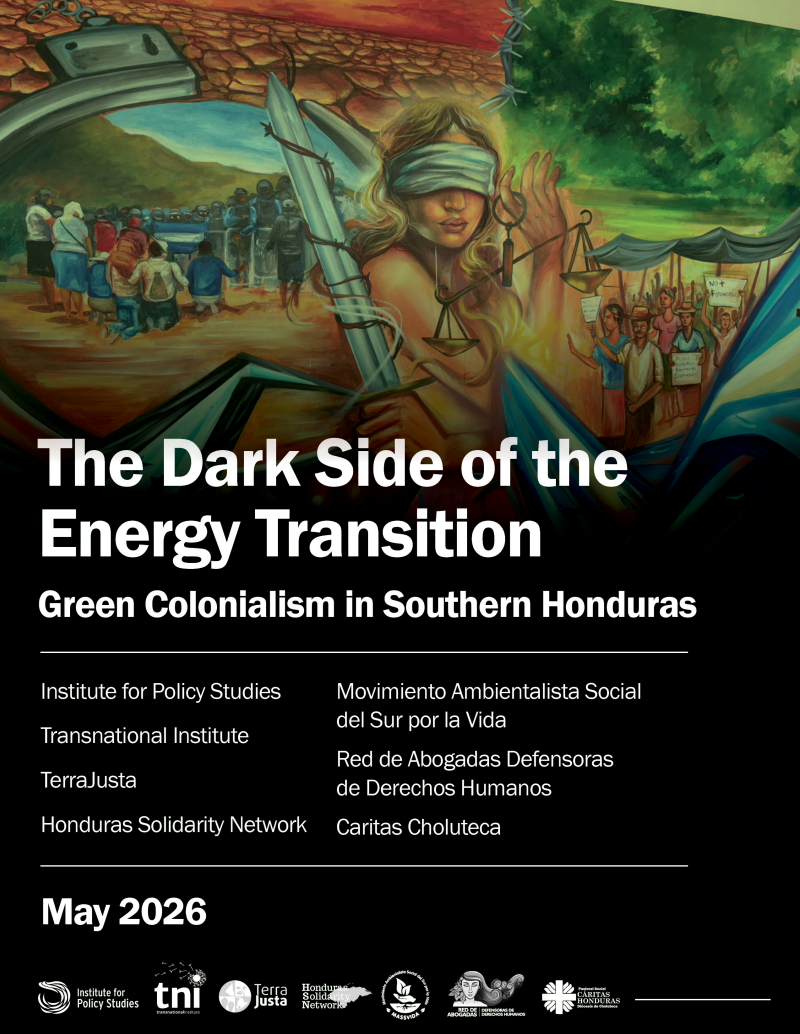
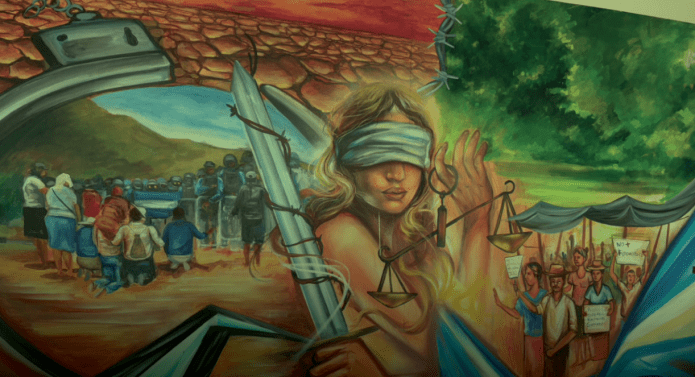
The Dark Side of the Energy Transition: Green Colonialism in Southern Honduras


Introduction
Countries around the world need to replace fossil fuels with renewable energy. But in some of the world’s most impoverished countries, the companies developing this technology are too often repeating the colonial, exploitative practices of the fossil fuel companies that came before them.
The installation of solar parks across southern Honduras, for example, tells a tale of corporate profiteering and bullying under the guise of “sustainable development.”
During the narcodictatorship in Honduras that followed the 2009 military-backed coup, transnational corporations benefited from exorbitant incentives to attract investment in the renewable energy market. In practice, they cynically exploited the call for green technology to profit from deepening privatization, corruption, and dispossession in one of the Americas’ most impoverished countries.
Solar parks did not replace fossil fuels in Honduras. Rather, they expanded the energy matrix without democratizing access to electricity, significantly reducing emissions, or benefiting local populations. What resulted was a massive transfer of public resources to private investors — and overpriced electricity for ordinary consumers.
Hondurans ended up paying some of the highest prices for electricity in Central America, while financing the profits of Norwegian and U.S. corporations, Central American elites, and international development banks. Campesino communities who resisted some of these projects — for example the Los Prados project in the municipality of Namasigüe — faced violent repression, forced displacement, and criminalization.
After the narcodictatorship, former President Xiomara Castro’s government (2022-2026) passed reforms to rescue the state electricity company by addressing some of the worst excesses in contracts with private energy generation companies. In response, Norwegian investors Scatec, Norfund, and KLP Norfund Investments brought multimillion dollar arbitration claims against the country.
Under many trade agreements, some national laws, and contracts, transnational corporations have exclusive access — via an arcane process known as Investor State Dispute Settlement (ISDS) — to sue governments in private tribunals when they make decisions that affect their profit expectations. This contrasts starkly with the lack of access to justice for affected communities.
This report — produced by the Institute for Policy Studies, Transnational Institute (TNI), TerraJusta, Honduras Solidarity Network (HSN), Network of Women Human Rights Defense Lawyers (RADDH), Southern Social Environmental Movement for Life (MASSVida), and Caritas Choluteca — explores how these developments represent a kind of “green colonialism.”
Some key findings and recommendations are below. You can read a summary PDF here or download a PDF of the full report here.
What is “Green Colonialism”?
Green colonialism, in this context, operates in three dimensions.
- The first is economic. Using ISDS and other means of protecting foreign investment, transnational corporations and their allies in governments prioritize profits while undermining both national sovereignty and the self-determination of local communities.
- The second is environmental. The threat of ISDS can dissuade countries like Honduras from adopting measures to protect the environment, undertake a meaningful energy transition, and ensure the well-being of people affected by extractivism.
- The third is racialized. Green colonialism is built on and reinforced by racism, treating territories and populations as sacrifice zones for the global economy, further marginalizing, exploiting, and impoverishing often racialized populations.
Key Findings
This report documents four ways in which “green colonialism” is at work through solar parks in southern Honduras.
- We document efforts to further dismantle the public state electricity company to install a corporate and privatized model of renewable energy provision. International financial institutions, such as the International Monetary Fund and the World Bank, supported reforms to introduce private energy generators into Honduras’s energy sector and later, in 2014, to split the National Electrical Energy Company (ENEE), Honduras’s state energy company, into privatized components: power generation, distribution, and transmission.
This step was designed to eliminate the Honduran state’s capacity to plan the energy sector in the public interest — and instead to maximize private profits. The ENEE became a compulsory purchaser of energy at exorbitant prices, through long-term supply contracts that guaranteed extraordinary profits for investors while raising costs for public coffers and the electricity bills of the Honduran people. - Multinational corporations and their supporters in government sought legal protections for private investors that would essentially eliminate risk. The post-coup regime in Honduras passed the Law for the Promotion and Protection of Investments in 2011, expanding recourse for transnational investors in Honduras to sue the government for millions of dollars using ISDS when they believe that decisions affect their profit expectations.
The Norwegian firms Norfund, KLP Norfund Investments, and Scatec were the first investors to make use of this law when they filed two ISDS claims against the Honduran government over modest reforms that, in part, aimed to address the financial crisis of the ENEE by renegotiating contracts for solar energy generation.
The total amount currently claimed by investors (USD $1.205 billion) exceeds the estimated savings that the Castro administration had expected to obtain from the renegotiation of renewable energy contracts during its term. There is also concern that the Norwegian claims, despite having been withdrawn in 2025, could have been used to pressure the Honduran government into negotiating or agreeing to the expansion of the controversial Los Prados project. - These firms have been undermining the self-determination and well-being of affected communities. Instead of climate justice, the results from imposing solar parks in one of the hottest and most impoverished regions of the country include false promises of jobs and economic development, deforestation, and loss of access to productive land and water sources — with temperatures still on the rise.
Communities who stood up and prevented the full installation of the Los Prados solar project have faced violent repression, forced displacement, and ongoing criminalization. 59 people were slapped with trumped up criminal charges between 2017 to 2019, and 10 are still required to report monthly to Honduran courts to ensure they fulfill their bail conditions as they await trial. - These solar parks represent another false solution designed to line the pockets of private corporations, not facilitate a just energy transition — much less energy democracy — in Honduras. In the departments of Choluteca and Valle, where privately owned solar parks are concentrated, more than 10 percent of the population still lacks access to electricity, while power outages are constant.
At the same time, solar panels generate energy that flows into the national market — benefitting the large consumers such as mining, cement, agribusiness, bottling, and maquila companies — without addressing the needs of the communities that bear the brunt of their impacts.
Recommendations
- Scatec, the Norwegian company operating the Los Prados project, should cease the criminalization of environmental defenders. And the Honduran and Norwegian governments should oblige the company to provide appropriate reparations for the harm they have suffered after more than eight years of persecution for peacefully defending their rights.
- The Los Prados project should be cancelled out of respect for the self-determination of the affected communities.
- The Honduran Public Prosecutor’s Office should bring to justice the 33 complaints filed against public officials for irregularities and acts of corruption in the approval of contracts for photovoltaic parks, as well as investigate any links in the energy sector between investors, companies, and public officials with organized crime.
- International Financial Institutions should ensure that no project that they finance has links to or involves investors with ties to organized crime.
- The Honduran government should ensure transparency regarding the ongoing ISDS claims and take steps to exit the ISDS arbitration system (as outlined in the report The Corporate Assault on Honduras).
- The Honduran government should prioritize international human rights, indigenous, environmental, and labor treaties regarding any future investments in the country, including an energy model based on energy justice and democracy.
Subscribe to our newsletter
Further reading

The True Cost of the Military in Hawaiʻi
The Dark Side of the Energy Transition: Green Colonialism in Southern Honduras